Use For:
- Deck piers
- Basketball goals
- Fences
- Mobile Homes
- Mailbox Posts
- Garages and Sheds
- Flagpoles
- Any project using concrete footers
-
Basketball goals
The QUIK-TUBE™ Building Form is a great way for homeowners and contractors to create everything from lamp post bases to deck supports.
QUIK-TUBE™ rigid fiber building forms are the ideal method of pouring cylinder-shaped concrete foundations for deck and porch supports and other load bearing applications. QUIK-TUBE™ forms can also be used to create attractive bases for lamp posts, fence posts, basketball net posts, mailbox posts and other post-setting applications. Such forms may also be required by frost line building codes.
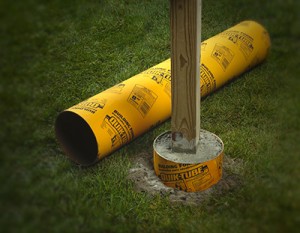
QUIK-TUBE™ forms allow you to place the strongest foundation possible. The inner walls of the form are waxed. This holds in the concrete’s water content, which results in maximum curing and strength build-up. Consider that when placed in a hole or dirt form, water can be sucked out of the concrete by the surrounding soil. This shortens curing time and reduces concrete strength. For this reason, many local building codes now specify the use of forms for all footers and foundations used in load-bearing applications.
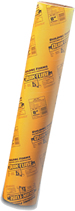
QUIK-TUBE™ forms are available in 8″, 10″ and 12″ nominal diameters. Each tube is 4′ long and can easily be cut to length using ordinary power tools. They can be left in place or stripped away after the concrete has cured for 24 hours. For the easiest removal and the smoothest concrete finish, apply a release agent to the inside of the forms.
Pressure-treated wood or metal posts can be secured to the footer by anchor plates or bolts embedded in the concrete. The posts themselves can also be embedded in the concrete to a depth that ensures complete support. The exact methods acceptable for load-bearing applications such as decks are subject to local building codes.
For example, in areas prone to termite problems, the code may specify the use of pressure-treated lumber attached to the footer using anchor plates. The elevation of the footer may be several inches above grade. These steps keep the lumber from direct contact with the soil, a condition that reduces the likelihood of termite problems.
Flag, basketball, and playground equipment poles may require embedding in concrete to certain depths, often up to 1/3 overall pole height. Check local codes and/or pole manufacturer recommendations.
Positioning the Form
- The diameter of the QUIK-TUBE™ form should be at least double the post or pillar diameter it will support. When supporting deck posts or other load-bearing members, the form should extend down below the frost line.
- Use a post hole digger or shovel to dig a hole to the proper depth. Do not make the hole wider than needed to minimize back-filling.
- Place 6″ of QUIKRETE® All-Purpose Gravel on the base of the hole to help with drainage.
- Cut the QUIK-TUBE™ rigid form to size. In most cases you will want to size the form so that the finished footing will extend out of the ground approximately 2″ to 6″. This protects lumber from direct contact with the ground and allows rainwater to drain rapidly from the area.
- Center the form in the hole. Check that the top of the form is level using a mason’s level.
- Carefully back-fill against the sides of the QUIK-TUBE™ form to support the tube and keep it from shifting during the pour.
- When forms are placed above ground in applications that will be back-filled later, make sure the bottom of the QUIK-TUBE™ is properly braced. Build a bottom collar out of scrap lumber, and keep the form plumb by adding braces above its midpoint as needed. Nail and stake all braces firmly in place.
Positioning the Post
When the post or pillar is to be embedded in the concrete, position it inside the QUIK-TUBE™ prior to beginning the pour. Use pressure-treated lumber or apply creosote equivalent to prevent below-the-ground rot. Coat metal posts with rust inhibitor. Center the post or pillar inside the form. Brace it as needed to prevent shifting during the pour and while the concrete sets. Use a mason’s level to make certain the post is plumb and its top is level.
Estimating the Concrete Needs
For a cylindrical form, such as QUIK-TUBE™, multiply the square of the form’s radius (one-half its diameter) by 3.1416. This gives you the area of the QUIK-TUBE™ form. Multiply this area by the form height to determine the volume of concrete needed. The table given below simplifies the calculation process for QUIK-TUBE™ jobs. It lists the bags of mix needed per linear foot of QUIK-TUBE™ form for the various tube diameters. For example, if you are using 50-pound bags of QUIKRETE® Fast-Setting Concrete, to pour the 8″ diameter, 4′ long form that calculation would be:
1 bag per linear foot x 4′ = 4 bags
If 80-pound bags of QUIKRETE® Concrete Mix were used, the calculation would be:
3/5 bag per linear foot x 4′ = 2 2/5 bags.
# of Bags of Bags of Concrete Needed Per Foot of Form Height
| QUIK-TUBE™ Diameter | 8″ | 10″ | 12″ |
| 50lb Fast-Setting Concrete | 1 | 1-2/5 | 2 |
| 80lb QUIKRETE® Concrete | 3/5 | 1 | 1-1/3 |
| 60lb QUIKRETE® Concrete | 4/5 | 1-1/4 | 1-1/3 |